
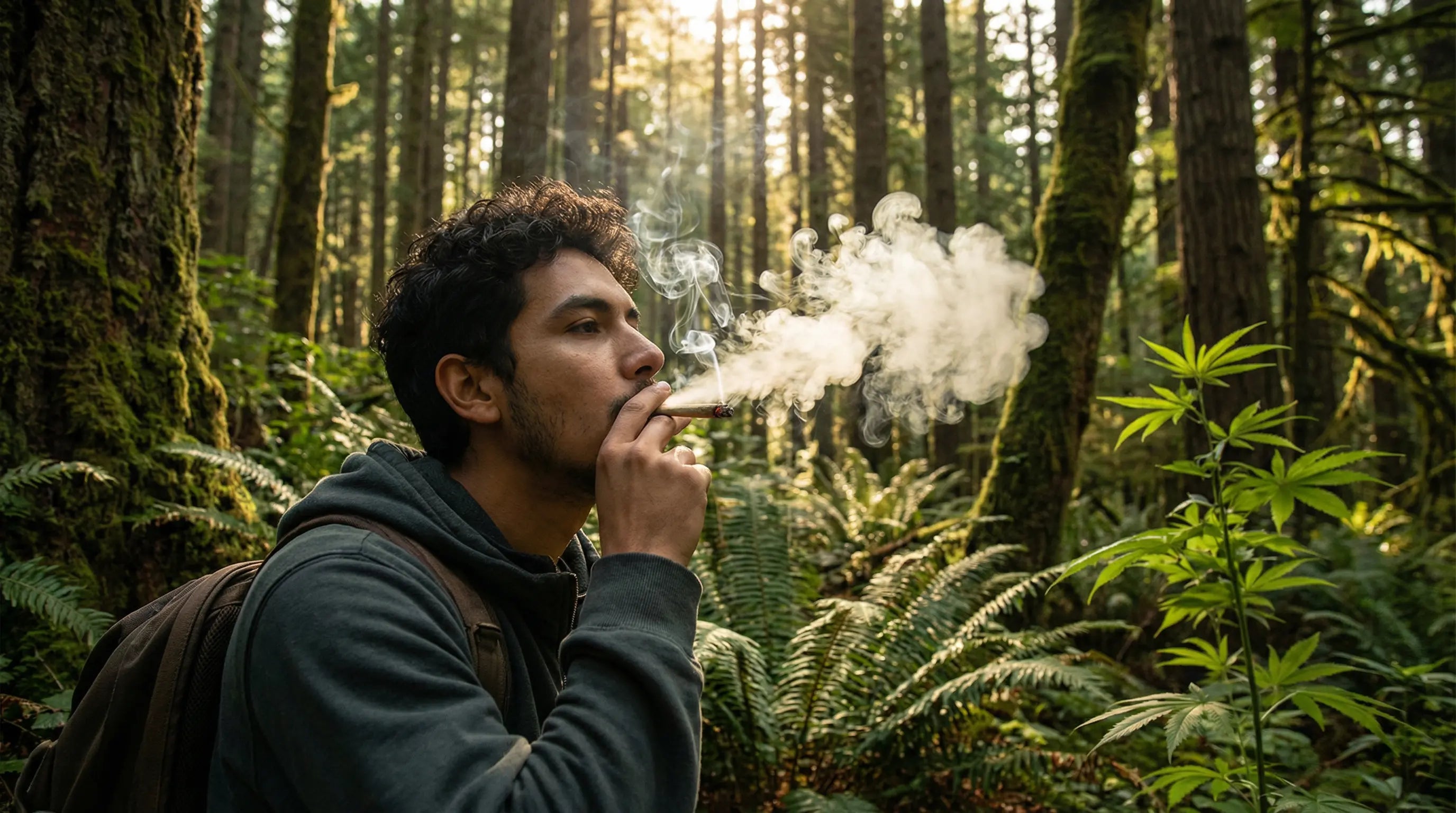
How Far Does Weed Smell Travel in Different Environments
Distance depends entirely on where you smoke and current conditions.
Outdoors on a calm day, cannabis smell stays within 20 to 30 feet. Wind changes everything - a steady breeze can carry that distinctive odor 100 yards or more across parks, parking lots, and residential streets. Indoors, the smell seeps through vents, electrical outlets, and door gaps. Apartment neighbors three units away might catch a whiff through shared HVAC systems.
Temperature and humidity amplify the problem.
Warm, moist air holds scent particles longer. Cold, dry conditions help odors dissipate faster. Building materials matter too - concrete walls contain smells better than drywall.
Understanding how far weed smell travels helps you smoke more discreetly and avoid complaints. This guide covers exact distances, environmental factors, and practical methods to hide weed smell for every situation.
How Far Does Weed Smell Travel Outside
Weather conditions dramatically change how far weed smell travels outside. On a windless day, expect the scent to stay within 20 to 30 feet of your location. Most people walking past at this distance will detect it clearly.
Wind transforms everything. A light breeze extends the range to 50 to 75 feet. Moderate winds can push odors 100 to 150 feet. Strong winds on open terrain have carried cannabis smell up to 300 to 400 feet, though intensity weakens with distance.
Elevation plays a surprisingly large role. Smoking on a balcony, rooftop, or hilltop allows scent molecules to disperse downwind across larger areas. Ground-level smoking in enclosed spaces like fenced backyards contains odors better than open fields or sidewalks.
Environmental Factors That Affect Outdoor Smell Distance
|
Factor |
Effect on Smell Distance |
Containment Strategy |
|
Wind speed |
Light breeze: 50-75 feet |
Smoke in sheltered areas, wait for calm conditions |
|
Temperature |
Warm air: Extends range by 20-30% |
Choose cooler times of day when possible |
|
Humidity |
High humidity: Smell lingers longer and travels farther |
Monitor weather conditions before outdoor sessions |
|
Terrain |
Open spaces: Maximum spread in all directions |
Use fences, hedges, or structures as windbreaks |
Time of day influences outdoor smell behavior. Morning dew and evening humidity hold scent particles in the air longer. Midday sun and dry afternoon air help odors dissipate faster. Rain actively washes scent molecules from the air, reducing detection range significantly.
Urban environments create unique patterns. Buildings reflect and channel air currents unpredictably. The smell might travel 30 feet in one direction but 100 feet in another due to architectural wind tunnels. Suburban and rural settings offer more consistent dispersion patterns.
Will My Neighbors Smell Weed Smoke Outside
Your neighbors will probably smell weed smoke outside if you're within 50 feet of their property during calm conditions. Wind extends this considerably. If you smoke on your back patio and they're sitting on theirs, expect them to notice even at 75 to 100 feet with any breeze.
Direction matters more than distance sometimes. Neighbors downwind will always detect the smell before those upwind. Even at 150 feet, a strong breeze can deliver noticeable odor directly to their yard or open windows.
Timing affects detectability, too. Evening sessions when neighbors are outside grilling or relaxing increase the chances they'll notice. Early morning or late night, when most people are inside, reduces detection probability.
Whether the smell goes inside your own home depends on proximity to doors and windows. Standing right next to an open door lets smoke drift inside easily. Moving 15 to 20 feet away with your back to the house keeps most odor outside, though some will still linger on your clothes when you return.
Physical barriers help significantly. Dense hedges, privacy fences, or garage walls between you and neighbors reduce how far away can you smell weed outside by blocking direct airflow. Our Ludist Stash Box keeps your flower fresh and odor-free before you smoke, preventing passive smell from stored cannabis.

How Far Does Weed Smell Travel Inside Buildings
How far does weed smell travel in house settings varies by construction quality and ventilation systems. In a typical single-family home, smoking in one room will make the entire house smell within 30 minutes to 2 hours. Doors don't contain odors effectively since smoke particles slip through gaps around frames.
Apartments present more complex scenarios. Smoke often travels through:
- Shared HVAC and ventilation systems
- Electrical outlets in common walls
- Plumbing gaps where pipes penetrate walls
- Cracks around baseboards and moldings
- Door gaps in hallways and common areas
In older apartment buildings, neighbors one or two units away frequently report detecting cannabis odor. Modern construction with better sealing reduces but doesn't eliminate transfer. I've seen cases where people living three floors up smelled smoke from a ground-floor unit through shared ventilation shafts.
Does Weed Smell Travel Through Walls
The smell of weed doesn't actually pass through solid walls. Instead, it travels through gaps, cracks, and openings you can't easily see. Drywall is porous enough that some odor molecules can penetrate over time, but the main culprits are construction imperfections.
Common pathways include gaps around electrical outlets and light switches, spaces where pipes penetrate walls under sinks and behind toilets, cracks in old plaster or drywall joints, gaps around door and window frames, and shared ductwork between units.
|
Building Type |
Smell Transfer Risk |
Primary Pathways |
Containment Difficulty |
|
Modern apartment (post-2000) |
Moderate |
HVAC systems, outlet gaps |
Medium |
|
Older apartment (pre-1980) |
High |
Multiple wall cracks, poor sealing |
High |
|
Single-family home |
Low to Moderate |
Through open doors/windows |
Low |
|
Condo with concrete walls |
Low |
Mainly through vents |
Low |
|
Duplex/townhouse |
Moderate to High |
Shared walls, attic spaces |
Medium to High |
Building age affects transmission significantly. Structures built before 1980 typically have looser construction standards with more gaps. Modern buildings seal better but still allow odor transfer through shared HVAC systems.
Wall materials influence containment. Concrete and brick block odors better than standard drywall. Soundproofing materials like dense insulation help contain smells too. But even well-built walls have penetrations for utilities that create odor pathways.
I know someone who lived in a newer condo with concrete walls between units. They never smelled their neighbor's smoke. But in their previous apartment with standard drywall, they could tell within minutes when someone nearby lit up.
Can Neighbors Smell Weed Through Walls
Proper storage prevents smell from escaping even when you're not smoking. While standard plastic bags offer minimal protection, do mason jars hold the smell of weed effectively? They work well for short-term storage, though specialized smell-proof containers provide better long-term containment.
Your neighbors can definitely smell weed through walls in most apartment buildings and condos. The smell rarely passes through the wall material itself. Instead, it travels through the same pathways that allow sound transmission between units.
Shared chase walls (walls containing plumbing for both units) are particularly problematic. The spaces around pipes create direct air channels between apartments. Bathroom and kitchen walls share plumbing runs, explaining why these rooms often smell strongly when neighbors smoke.
HVAC systems in multi-unit buildings recirculate air between apartments. Older buildings especially lack proper sealing between units' ductwork. When your furnace or AC runs, it can pull air and odors from surrounding apartments.
The smell intensity depends on ventilation quality and how much your neighbor smokes. Light, occasional use might create brief whiffs. Heavy daily smoking can make your entire apartment reek constantly.
How long can neighbors smell weed through walls varies from 30 minutes to 72 hours, depending on ventilation. With windows closed and no air circulation, the odor can linger for days in both the smoking apartment and adjacent units.
How Long Does Weed Smell Stay in My Room
How long weed smell stays in a room depends on ventilation, materials, and smoking volume. With windows closed and no airflow, expect the odor to persist 6 to 12 hours from a single joint. Smoking multiple bowls or sessions extends this to 12 to 24 hours.
Opening windows and fans changes everything. Good cross-ventilation can clear noticeable smoke smell in 1 to 2 hours. Running an air purifier speeds this up further, potentially clearing the air in 30 to 60 minutes.
Surface absorption matters significantly. Fabric furniture and curtains absorb odor and release it slowly over days, while carpets trap smell particles, requiring deep cleaning to fully remove them. Hard surfaces like wood and tile don't retain odors as long, and painted walls absorb some smell but release it within hours when exposed to fresh air.
Whether the smoke gets inside your home if you smoke outside depends on wind direction and door/window positions. Smoking right next to an open door or window will push smoke inside. Moving 15 to 20 feet away keeps most odor outside, though you'll carry some smell on your clothes.
Clothing transfers odors heavily. Smoking indoors means your clothes, hair and skin absorb the smell. When you move through your house, you spread these molecules into other rooms. This explains why the smell seems to travel EVERYWHERE, even when you smoke in just one space.
The best way to keep weed fresh and minimize passive odor is to use a quality stash jar, which creates an airtight seal that contains terpenes inside.

If I Smoke Outside, Will It Smell Inside?
If you smoke outside, the smell can still get inside through several pathways. Open windows and doors create direct routes for smoke to enter. Even if you're 20 feet from an open window, wind can carry the odor directly inside.
Air pressure differences between indoors and outdoors affect smell infiltration. When your AC or heat runs, it creates negative pressure that pulls outdoor air and smells inside through gaps around windows and doors, attic vents, roof penetrations, cracks in siding or foundation and utility entry points.
Your clothes become smell carriers. Smoking outside means your clothing, hair and hands absorb cannabis odor. Walking back inside spreads these molecules throughout your home.
Proximity to the building determines transfer likelihood. Smoking directly against an exterior wall or under an overhang traps smoke near the building where it seeps inside. Moving at least 25 to 50 feet away reduces indoor smell infiltration dramatically.
Factors That Determine How Far Weed Smoke Travels
How far does weed smoke travel combines multiple environmental and situational variables. Understanding these factors helps predict and control odor spread in any setting.
Airflow and Ventilation
Wind speed ranks as the single biggest factor in outdoor odor dispersion. Still air keeps smell within 20 to 30 feet. Light breezes extend range to 50 to 100 feet. Moderate winds can push odors 150 to 200 feet. Strong winds on open terrain have carried cannabis smell up to 400 feet in documented cases.
Indoor airflow patterns determine the spread of smells inside buildings. Forced air heating and cooling systems circulate smoke throughout entire homes and into neighboring apartments through shared ductwork. Opening windows on opposite sides of a room creates cross-ventilation that expels smoke faster than a single open window.
Natural convection moves smoke upward as it warms. In multi-story buildings, this means smoke rises to upper floors even without fans or HVAC systems. Stairwells act as chimneys, pulling smoke from lower levels to upper ones.
Temperature and Humidity Effects
Temperature influences how far and how fast odor molecules travel. Warm air expands and rises, carrying scent particles higher and farther. Heat also makes terpenes more volatile, increasing their concentration in the air. Summer smoking sessions produce stronger, more far-reaching odors than winter ones.
Cold air is denser and slows molecular movement. Winter smoking keeps odors closer to ground level and reduces travel distance by 15 to 25 percent compared to summer conditions.
Humidity acts as an odor carrier. Water vapor in humid air attracts and holds scent molecules, making them detectable at greater distances. Humid summer evenings can extend smell range by 30 percent or more versus dry conditions. This explains why the smell lingers longer on muggy days.
Building Materials and Construction
Construction quality dramatically affects how does weed smell travel inside. Modern buildings with proper vapor barriers and sealed ductwork contain odors better than older structures. But even new construction has penetrations for utilities that allow smell transfer.
Concrete walls and floors provide excellent odor barriers. The dense material doesn't allow air or odor molecules to pass through easily. Steel-framed buildings with concrete offer the best odor containment for multi-unit housing.
Standard drywall on wood framing offers minimal odor resistance. The material itself is somewhat porous, and gaps around studs, outlets, and fixtures create numerous pathways for air and smell movement. Most apartment buildings use this construction, explaining widespread odor complaints.
Insulation type matters less than sealing quality. Spray foam insulation that seals gaps and cracks helps contain odors. Standard fiberglass batts do little to prevent smell transfer since they don't seal air pathways.
Does Weed Smoke Rise or Fall Outdoors
Weed smoke rises outdoors initially due to heat from combustion. Hot smoke is less dense than the surrounding air, creating buoyancy that lifts it upward. This rising action can carry smoke 10 to 20 feet vertically before it cools and begins dispersing horizontally.
Once smoke cools to ambient temperature (usually within seconds), it behaves like air and follows wind patterns. On a completely calm day, cooled smoke will eventually settle toward the ground due to particle weight. But even slight air movement disperses it horizontally before significant settling occurs.
Elevation and slope affect smoke behavior. Smoking on a hilltop or balcony allows smoke to drift downward with terrain, potentially reaching ground level far from the source. Valleys or low-lying areas can trap cooled smoke near the ground longer.
Weather inversions create unusual patterns. Cold air trapped under warm air layers prevents vertical dispersion, keeping smoke low and concentrated. This happens frequently in the early morning or during winter high-pressure systems.
How to Reduce and Control Weed Smell
How to hide weed smell combines prevention, active removal and odor-masking techniques. The most effective approach uses multiple methods together rather than relying on a single solution.
How to hide weed smell combines prevention, active removal and odor-masking techniques. The most effective approach uses multiple methods together rather than relying on a single solution. For a comprehensive overview of every proven method, our guide on how to hide weed smell covers strategies for every situation from apartments to cars.
Proper Storage Reduces Passive Odor
Unsmoked cannabis releases terpenes constantly. An open bag or poorly sealed container lets these molecules escape into your space, creating a persistent odor even when you're not smoking. Every time you open storage, you release a concentrated burst of smell.
Airtight containers are non-negotiable for serious odor control. Glass mason jars with rubber gaskets provide good sealing. But for truly smell-proof storage, check out our best smell-proof jar for marijuana guide for containers specifically designed for cannabis.
Many people wonder if medicine bottles smell proof for cannabis storage. While some prescription bottles seal adequately for short trips, they're not designed for long-term odor containment and often let terpenes escape gradually.
Active Smoke Removal Methods
Ventilation ranks as the most effective active removal method. Opening windows on opposite sides of a room creates cross-flow that removes smoke quickly. Pointing a box fan out the window actively expels smoke rather than just mixing it around.
Effective ventilation strategies include:
- Opening windows on opposite walls for cross-ventilation
- Using box fans pointed outward to create negative pressure
- Running bathroom exhaust fans during and after sessions
- Creating airflow from the lower intake to the higher exhaust points
Air purifiers with HEPA filters and activated carbon remove smoke particles and odor molecules from indoor air. Place the purifier near your smoking location for maximum effectiveness. Run it for 30 to 60 minutes after smoking to clear the air.

Bathroom fans that vent directly outside work excellently for small-space smoking. Running the shower creates steam that helps carry smoke particles out through the fan. This method isn't foolproof but significantly reduces odor compared to no ventilation.
Sploofs and smoke filters capture some smoke as you exhale. Homemade versions use dryer sheets in a cardboard tube. Commercial filters contain activated carbon for better odor absorption. These reduce but don't eliminate smell, especially from the burning end of joints or bowls.
Odor Masking and Neutralization
Masking and neutralization work differently. Masking covers one smell with another, while neutralization chemically alters odor molecules so they can't trigger smell receptors.
Masking options include:
- Incense or scented candles burned during sessions
- Essential oil diffusers running continuously
- Air freshener sprays (though these can create obvious "covering up something" signals)
- Cooking strong-smelling foods that naturally mask other odors
Discover what smell covers weed most effectively, including specific perfume recommendations and household scents that work best.
Activated charcoal truly neutralizes odors rather than masking them. Charcoal bags placed in rooms absorb odor molecules over time. They work passively and continuously but take days to fully clear accumulated smells.
Commercial odor neutralizers use enzymes or chemical reactions to break down smell molecules. Products like Ozium actually eliminate odors at the molecular level rather than just covering them temporarily.
For comprehensive odor control strategies, our article on the best way to hide weed smell in a room covers every effective technique in detail.
Outdoor Smoking Strategies
Smoking outside remains the simplest way to avoid indoor odor problems. But location and technique still matter for discretion and neighbor considerations.
Choose locations away from windows, doors, and HVAC intakes. Standing directly under an air conditioning unit or heat pump will pull smoke into your home's ventilation system. Move at least 30 feet from any building opening.
Best practices for discrete outdoor smoking:
- Choose locations downwind from neighboring properties
- Use natural barriers like trees, fences, or structures as windbreaks
- Stay aware of changing wind direction throughout your session
- Position yourself with wind at your back, blowing away from structures
Timing affects detectability. Smoking during busy times when neighbors are active increases the chances someone will notice. Early morning or late evening when most people are inside reduces detection probability.
Weather awareness helps minimize the spread. Calm days with low wind keep the odor more localized. Waiting for breezy conditions actually extends smell range significantly, though it dissipates faster.
Wearing a designated smoking jacket prevents odor transfer to your regular clothes. Leave it outside or in a garage after smoking. This single habit dramatically reduces how much smell you carry back inside.
If you smoke a joint outside, will you smell? Absolutely yes, though the intensity and duration are less than indoor smoking. Your hands, hair and breath will carry odor for 30 minutes to several hours, depending on the amount smoked.
How Long Does Weed Smell Last in Different Settings
How long does weed smell last depends heavily on the environment, ventilation, and absorption by surrounding materials. Understanding these timelines helps plan sessions and manage odor concerns.
How Long Does Weed Smell Last with Window Open
With a window open during smoking, the noticeable smoke smell typically clears from a room within 1 to 2 hours. Active ventilation using a fan pointed out the window reduces this to 30 to 60 minutes for the most obvious odors.
Light residual smell can persist for 3 to 6 hours even with windows open. Fabrics, carpets and upholstered furniture absorb odor molecules and release them slowly over time. This explains why a room might smell faintly hours after smoke has visually cleared.
Multiple sessions in the same space create cumulative absorption. Smoking daily in one room with window ventilation will eventually saturate fabrics and surfaces, creating a persistent background odor that takes days to dissipate fully, even after stopping.
Temperature affects dissipation speed. Warm summer air encourages faster molecular movement and dispersion. Cold winter air slows everything down, potentially doubling the time needed to clear smells.
How Long Does Weed Smell Last Outside
How long the smell of weed lasts outside varies from minutes to several hours based on conditions. In ideal situations with moderate wind and dry air, the concentrated smoke smell dissipates within 10 to 30 minutes of finishing.
Calm, humid days extend detection time significantly. Still air on a muggy summer evening can keep localized odor present for 1 to 2 hours. The smell stays more concentrated without wind to disperse it, making it detectable longer.
How long does weed smell linger outside near your smoking location? Ground-level residue on grass, concrete or wood surfaces can hold a slight odor for several hours after visible smoke clears. This is most noticeable in enclosed areas like covered patios or sheds.
Rain actively removes odor molecules from the air. During or immediately after rainfall, cannabis smell dissipates 50 to 75 percent faster than dry conditions. This makes rainy days optimal for discrete outdoor sessions, though practicality suffers.
Indoor Smell Duration Without Ventilation
From a single joint or bowl, expect a noticeable smell linger in enclosed spaces without active ventilation odor for 6 to 12 hours in a closed room. Heavy smoking or multiple sessions extend this to 12 to 24 hours.
Fabric absorption creates long-term odor retention. Smoking regularly in a carpeted room with upholstered furniture can create a persistent smell that lasts days or weeks even after stopping. The fabrics absorb so many odor molecules that they continue releasing them long after air quality improves.
Smoking in cars is particularly problematic. The small enclosed space with abundant fabric and limited air circulation creates concentrated absorption. How long does weed smell last in car interiors? Even with windows open afterward, expect 2 to 4 days of noticeable odor. Hotboxing or smoking with windows closed can create a smell that persists for weeks.
Temperature cycling in closed spaces affects persistence. AC and heating systems move air around, helping distribute and eventually dissipate odors. Completely stagnant air in unused rooms can hold smells surprisingly long.
Specific Scenarios and Solutions
Different living situations present unique challenges and opportunities for odor management. Here's how to handle common scenarios.
Apartment Living and Shared Spaces
Living in an apartment means understanding how far away you can smell weed outside is only part of the problem. Indoor odor transfer through shared systems creates the bigger challenge.
Bathroom fans offer your best ventilation option in apartments without balcony access. Most bathroom fans vent directly outside rather than into shared ductwork. Running the fan and a hot shower during sessions helps remove smoke, though some smell still escapes into the hallways through the door gaps.
Sealing your apartment reduces the inflow and outflow of odors. Weather stripping on doors, caulking around outlets and blocking gaps under doors with door sweeps all help contain smells within your unit. This cuts both ways, though, protecting you from neighbors' odors while containing your own.
Communication with nearby neighbors prevents conflict. If you smoke regularly, having a friendly conversation before complaints arise shows consideration. Some neighbors won't mind, while others may be very sensitive. Knowing preferences helps you adjust habits or find alternative solutions.
For comprehensive storage options in shared living spaces, consider our best stash box guide which compares features, smell-proofing capabilities and discretion levels. If security is a concern in shared living spaces, explore lockable stash boxes that provide both odor containment and physical security.

Smoking in Cars and Vehicles
Vehicles are particularly difficult to deodorize. Small interior volume combined with abundant fabric (seats, headliner, carpet) creates maximum absorption potential. Between choosing the right storage containers and knowing where to position yourself when smoking nearby, managing cannabis odor in vehicles requires multiple tactics working together. Our article on how to hide weed in car covers everything from glove box storage to dealing with police encounters.
Rolling windows down helps, but doesn't prevent smell entirely. Most smoke still contacts interior surfaces before exiting. For true odor reduction in vehicles, avoid smoking inside completely.
If you must smoke in a car, crack all windows fully and keep moving. Air circulation while driving expels smoke faster than stationary hot-boxing. Park downwind of yourself when stopped to keep smoke blowing away from the interior.
Storing cannabis in vehicles requires smell-proof containers. Any gap in sealing will let odor escape, eventually permeating the entire interior.
Balcony and Patio Smoking
Balcony smoking seems ideal, but creates distinct challenges. If you smoke on your balcony, will it smell inside? Almost certainly yes if any doors or windows are open, and often even when they're closed due to air pressure differences.
Wind direction determines whether smoke enters your unit or your neighbors'. Standing at the balcony edge with your back to the building and the wind blowing away helps, but shifts in breeze direction can reverse this quickly.
Upstairs neighbors often smell balcony smoke as it rises. Downstairs neighbors might smell it less due to upward drift, though this isn't guaranteed. Side-by-side neighbors definitely smell it if the wind blows toward their balconies.
Timing matters significantly for balcony sessions. Smoking when most neighbors are at work or late at night reduces detection probability. Avoid prime evening hours when everyone is outside grilling or relaxing.
Growing Cannabis and Smell Management
The question of how far weed smell travels becomes critical when growing indoors. Mature flowering plants produce a constant, intense odor that will fill your entire home and extend into neighboring units without proper control.
Carbon filters rated for your grow space size are non-negotiable. These filters scrub air of terpenes before expelling it, dramatically reducing detectable odor. Match the filter CFM (cubic feet per minute) rating to your exhaust fan and grow tent size.
Grow tents with sealed zippers and durable fabric contain odors better than open growing. Combined with an inline fan and carbon filter, a proper tent setup can reduce detectable odor to nearly zero during vegetation. Flowering still produces noticeable smell, but at manageable levels.
Ozone generators destroy odor molecules but must be used carefully. Run them in adjacent rooms or hallways, never in your grow space where they can affect plant health and flavor. Ozone is harsh on the lungs, so ventilate thoroughly before spending time in treated areas.
Product Tools and Accessories for Smell Control
The right accessories significantly improve odor management effectiveness. Some tools work better than others for specific situations.
Storage Solutions That Actually Work
Standard plastic bags and containers let odor escape freely. Even thick freezer bags reduce smell by maybe 30 to 40 percent at best. For real containment, you need purpose-built solutions.
Glass jars with rubber gasket seals provide excellent basic storage. Mason jars work well and are widely available. The tight seal prevents most terpene escape. UV-protective glass helps too, though that's more about freshness than smell.
Vacuum-sealed bags remove all air, minimizing oxidation and odor release. They're excellent for long-term storage but inconvenient for daily use since you must re-seal after every opening.
Grinding and Preparation Tools
How you prepare cannabis affects smell intensity.
Hand-breaking produces less immediately noticeable odor since you're not exposing as much surface area at once. But it's messier and wastes material.
Grinders increase surface area dramatically, releasing concentrated terpene bursts when you open the lid. This creates a brief but intense smell spike. Grinding immediately before smoking rather than in advance reduces how long this concentrated odor lingers.
Our Ludist grinder features precision-machined teeth and a kief catcher that captures trichomes while minimizing mess. The quality construction means you can grind quickly and efficiently reducing the time your flower sits exposed to air. For a comprehensive comparison of all options, explore our best weed grinder guide.
Keeping your grinder clean prevents residue buildup that creates persistent odor. Knowing how to clean a weed grinder properly helps extend your grinder’s lifetime and is the key to maintaining freshness.
Rolling and Smoking Accessories
Rolling surface choice affects tidiness and smell containment. High-quality rolling trays provide a dedicated space that catches all loose material and prevents it from spreading across surfaces where it will continue releasing odor.

Pre-rolls stored properly don't smell much. But keeping them exposed in a pocket or loose in a drawer lets terpenes escape continuously. Use small smell-proof tubes or a compartment in your stash box for pre-roll storage.
Managing Lingering Smell on Clothes and Body
Personal odor transfer happens more readily than most people realize. Smoke particles adhere to skin, hair, and fabric easily, turning you into a mobile smell source long after you’ve finished smoking.
How Long Does Weed Smell Stay on Clothes
Cannabis odor stays on clothes 4 to 8 hours under normal conditions. Synthetic fabrics like polyester hold smell longer than natural fibers like cotton. Thick fabrics like denim and fleece absorb more than thin t-shirts.
Washing removes odor completely from most fabrics. Adding a cup of white vinegar to the wash cycle helps break down odor molecules in particularly saturated items. Air drying in direct sunlight provides additional deodorizing benefits that machine drying can't match.
Immediate odor reduction strategies for clothes:
- Remove outer layer immediately after smoking if discretion matters
- Hang clothes outside to air out before bringing them back inside
- Use fabric spray designed specifically for smoke odor removal
- Store smoking clothes separately from regular wardrobe to prevent transfer
- Keep a dedicated smoking jacket or hoodie that stays outside
- Avoid fabrics like fleece and wool that absorb odors intensely
- Choose synthetic materials that release smells more easily when possible
Will you smell like weed if you smoke outside? It depends on proximity and smoke exposure. Staying upwind of your joint reduces how much smoke drifts back onto you. The first few puffs generate the most smoke that can settle on clothing.
Hair and Body Odor Duration
Hair absorbs smoke smell readily and holds it for 4 to 12 hours, depending on length and texture. Longer, thicker hair holds more odor molecules. Washing your hair completely removes the smell, but that's not always practical immediately after smoking.
Quick fixes for hair and body odor:
- Dry shampoo absorbs odor molecules and adds masking fragrance
- Hair perfume or scented leave-in conditioner covers lingering smell
- Pull hair back during smoking to reduce direct smoke exposure
- Wear a hat or hood to shield hair from smoke contact
- Wash hands and face immediately after finishing
- Use hand sanitizer if soap and water aren't immediately available
- Brush teeth or use mouthwash to address breath odor
For strategic scent layering that masks cannabis odor without seeming obvious, check out our recommendations for the best perfume to cover up weed smell. The right fragrance choice makes a significant difference in how detectable residual odor remains.
Skin absorbs less odor than fabric or hair, but still carries smell for 2 to 4 hours. Washing hands and face immediately after smoking removes most noticeable odor. Your breath may smell longer, especially when smoking blunts or joints with direct mouth contact.
Do you smell like weed if you smoked outside? Others will probably notice within arm's length for at least an hour or two after your session. Heavy smoke exposure extends this significantly.
Legal and Social Considerations
How far does marijuana smell travel affects more than just discretion. In some situations, odor can create legal or social consequences.
Neighbor Complaints and Legal Issues
The legal question of neighbors smelling your weed smoke matters less than whether it actually bothers them. Even in states where cannabis is legal, you can't create nuisances that substantially interfere with neighbors' quiet enjoyment of their property.
Documented cases exist where persistent odor led to legal action even in legal states. One DC resident successfully sued her neighbor for cannabis smell infiltrating her home through shared vents. The court ordered the neighbor to stop smoking indoors despite medical marijuana being legal in the district.
Police response to complaints about neighbors smoking weed depends entirely on local laws and complaint severity. In legal states, police generally won't respond to odor complaints alone. In illegal states, persistent smell can provide probable cause for investigation.
Building policies often prohibit smoking regardless of legal status. Many apartments and condos ban all smoking due to fire risk and odor complaints. Violating these lease terms can lead to fines or eviction, even when you're following state law.
Communication prevents most conflicts. When neighbors complain about smell, adjusting your habits often resolves the issue without legal involvement. Switching to edibles, smoking off property or improving ventilation demonstrates good faith effort.
Public Spaces and Discretion
How far cannabis odor travels from your property depends on where you smoke relative to public spaces. Front yards near sidewalks create maximum exposure to passersby. Back yards provide more privacy but aren't completely discrete.
Public consumption laws vary widely. Some legal states allow public smoking, while others prohibit it even though possession is legal. College campuses usually ban smoking regardless of state law. Understanding local regulations prevents unnecessary trouble.
Social etiquette matters beyond legal requirements. Smoking near playgrounds, schools or family areas draws more attention and complaints than smoking in your own backyard at night. Being considerate of time and location reduces conflict potential.
Keeping Cannabis Fresh While Managing Smell
Keeping cannabis fresh and managing smoke odor go hand in hand. Proper storage prevents degradation while containing smells effectively.
Storage Duration and Smell Control
How long can you store weed properly depends on storage conditions. In airtight containers at controlled humidity, cannabis maintains quality for 6 to 12 months. But improper storage degrades terpenes within weeks, affecting both smell intensity and quality.
|
Storage Method |
Freshness Duration |
Smell Containment |
Best Use Case |
|
Airtight glass jar |
6-12 months |
Excellent |
Long-term storage, daily use |
|
Smell-proof stash box |
6-12 months |
Outstanding |
Premium storage, travel |
|
Vacuum-sealed bag |
12+ months |
Excellent |
Long-term preservation |
|
Plastic bag |
1-3 weeks |
Poor |
Temporary only, not recommended |
|
Medicine bottle |
1-3 months |
Fair to Good |
Short-term storage |
Our guides on how long weed lasts and how to store marijuana cover optimal preservation methods in detail.

Temperature stability prevents terpene loss. Heat accelerates degradation and increases vapor pressure, making sealed containers release more odor when opened. Cool, dark storage maintains quality the longest.
Humidity control at 55 to 65 percent RH preserves freshness while minimizing mold risk. Too dry causes terpenes to evaporate faster, increasing smell when you open the storage. Too humid risks mold that produces terrible odors and ruins your flower completely. For comprehensive preservation techniques, see our guide on how to keep weed fresh.
Container Selection Strategy
Different storage needs require different solutions. Daily-use flower benefits from easily accessible containers with good seals. Long-term storage needs maximum protection even at the cost of convenience.
Key features to look for in cannabis storage containers:
- Airtight sealing: Rubber gaskets or threaded lids that prevent air exchange
- Opaque or UV-protective materials: Block light that degrades cannabinoids and terpenes
- Appropriate size: Not too large (excess air accelerates degradation) or too small (compresses buds)
- Durable construction: Glass, metal, or high-quality plastics that won't crack or warp
- Easy maintenance: Smooth interiors that clean easily without trapping residue
- Humidity control compatibility: Space for humidity packs if needed
Using these criteria methods, finding the best stash jar for you will drastically improve your odor containment and discretion, while preserving the freshness of your fine flower.

For daily use, you can balance easy access with reliable sealing. You can open it for a quick bowl without releasing excessive odor into the room.
Long-term storage works best with vacuum sealing or multiple containment layers. Place cannabis in a smell-proof bag inside an airtight jar for maximum protection. Store in cool, dark locations away from temperature fluctuations.
Pre-rolls need special consideration since paper absorbs odor. Store them in tubes or a dedicated compartment rather than loose in your main stash container. This prevents cross-contamination between stored flower and ground material.
Advanced Odor Control Techniques
For situations requiring maximum discretion, basic methods may not suffice. These advanced techniques provide additional containment layers.
Creating Negative Air Pressure
Negative air pressure means the area inside a room has lower pressure than outside. This causes air to flow inward through any gaps rather than outward, containing odors within the space.
Creating negative pressure requires exhaust capacity exceeding intake. If your room exchanges 200 cubic feet of air per minute out through a fan but only has small gaps letting 150 CFM in, you've created -50 CFM of pressure difference.
This technique works best in rooms with a single door and sealed windows. Crack the door slightly and run a powerful exhaust fan in the window. Air will flow in through the door gap and out the window, carrying smoke with it while preventing smell from escaping through other paths.
Grow operations use this principle extensively. Proper negative pressure keeps the smell inside the tent and growing area even when room doors open. Without it, odor escapes every time you enter the space.
Chemical Odor Neutralization
Some products chemically alter odor molecules rather than masking them. These work better than air fresheners for true smell elimination.
Effective chemical neutralization methods:
- Activated charcoal: Absorbs and traps odor molecules in porous surface structure
- Ozone generators: Break down molecules through oxidation (use carefully, harsh on lungs)
- Enzyme-based cleaners: Target specific compounds in cannabis smoke chemically
- Hydroxyl generators: Safer alternative to ozone for occupied spaces
- Photocatalytic oxidation devices: Use UV light to break down odor molecules
- Ionizers: Release charged particles that attach to and neutralize odors
Activated charcoal absorbs and traps odor molecules in its porous surface. Charcoal bags placed in rooms work passively over days and weeks, gradually reducing accumulated smells. They need replacement every few months as pores saturate.
Ozone generators break down odor molecules through oxidation. They're extremely effective but must be used carefully since ozone is harsh on lungs. Run them in unoccupied rooms and ventilate thoroughly before returning.
Enzyme-based cleaners designed for smoke odor break down the specific compounds in cannabis smoke. These work better than general cleaners for removing absorbed smell from surfaces.
Masking Plants and Natural Scents
Growing aromatic plants near outdoor cannabis can mask the smell naturally. Lavender, jasmine, rosemary and mint produce strong scents that blend with and partially cover cannabis odor.
This technique works better for growing operations than smoking since plant smells are constant. A few pots of aromatic herbs on your balcony provide a continuous masking scent during smoking sessions.
Inside, cooking strong-smelling foods like curry, garlic, or bacon creates temporary masking that doesn't seem suspicious. The food smell is natural and expected, unlike incense or air freshener, which may signal you're covering something up.
Coffee grounds absorb odors while releasing their own strong scent. Small bowls of fresh grounds placed near smoking areas provide dual-action odor control.
What Makes Weed Smell So Strong?
The pungent cannabis odor comes from terpenes. These organic compounds give each strain its signature scent profile. Myrcene creates that earthy, musky aroma. Limonene adds citrus notes. Pinene smells like pine trees. Caryophyllene brings spicy pepper tones. Understanding the aromatic compounds and how these terpenes work and why they matter beyond smell is the key to really appreciating your flower.
Cannabis contains higher terpene concentrations than most plants. During flowering, mature plants produce these compounds at peak levels. When you smoke, heat releases volatile terpene molecules into the air, where they travel efficiently.
Burning plant material adds another layer. Combustion creates additional odor compounds that mix with terpenes to produce that unmistakable weed smoke smell. This combination makes cannabis smoke more noticeable than the unburned flower alone.
Different consumption methods affect smell intensity:
- Joints and blunts: Maximum odor from burning paper and plant material
- Bongs and pipes: Less paper smell but still strong cannabis odor
- Vaporizers: Reduced smell since material heats instead of burns
- Edibles: No smoke odor during consumption
The strain matters significantly. Some varieties, like Skunk, are bred specifically for powerful aromas. Others produce milder scents that travel shorter distances.
Master Cannabis Odor Control Through Smart Habits
How far can weed smell travel matters less when you combine multiple odor control strategies. No single method provides perfect containment, but layering techniques creates reliable discretion.
Our experience shows that proper storage prevents most passive odor issues before they start. The Ludist stash box eliminates that constant background terpene smell that many users don't even realize they're creating. The lid doubles as a rolling tray, keeping your preparation contained and preventing loose material from spreading across surfaces. For those who prefer individual jar storage, our high-quality stash jar creates an airtight seal that contains terpenes inside.

Active smoking requires ventilation, timing, and location awareness. Smoking outdoors with attention to wind and neighbor proximity reduces detection dramatically versus careless indoor sessions.
Personal habits like designated smoking clothes, immediate hand washing and waiting before returning to shared spaces show consideration while protecting your discretion.
Understanding exactly how far marijuana smoke travels in your specific environment lets you make informed decisions. Test different locations, note wind patterns and pay attention to when the smell becomes detectable at various distances.
This knowledge becomes your foundation for consistent discretion.

Leave a comment
This site is protected by hCaptcha and the hCaptcha Privacy Policy and Terms of Service apply.