
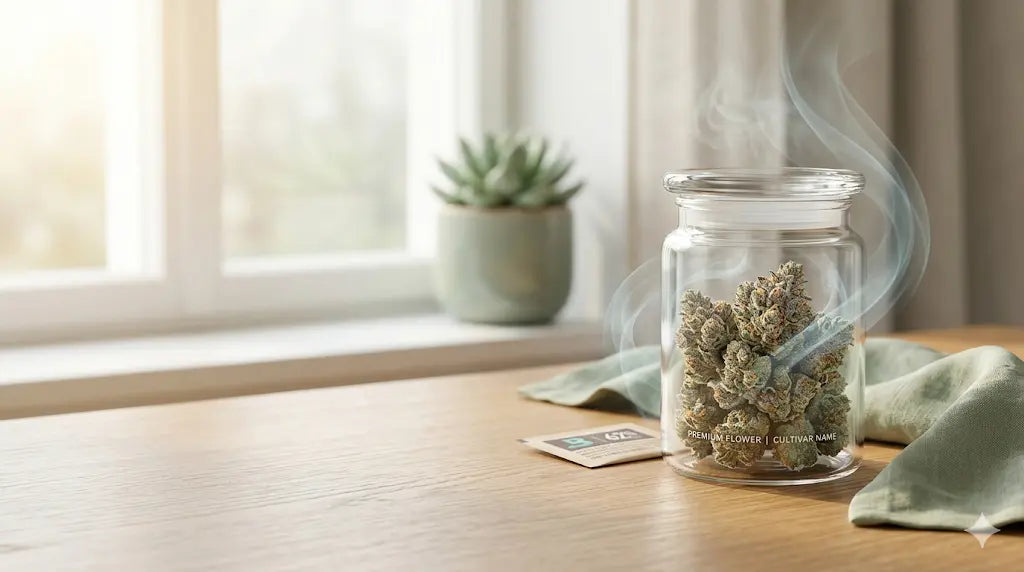
Terpene Shield - What It Is, How It Works, and Why Proper Storage Needs One
Terpene shield packets are one of the most overlooked tools in cannabis storage, even though losing terpenes is the number one reason fresh flower goes flat within weeks. Without one, premium flower can lose 15-30% of its terpene content in as little as three weeks of standard storage. I learned this the hard way after keeping an expensive eighth in a plastic bag for a month - it smelled like nothing when I finally opened it. Here you'll learn what a terpene shield actually is, how the technology works, which humidity level to choose, how to use one correctly, and how it compares to terpene sprays and other products on the market.
Terpene Shield - What It Actually Is and How It Works
A terpene shield has two related meanings in cannabis circles. The first is a biological concept: the natural monolayer of water molecules that forms around trichomes during proper curing, slowing terpene evaporation by creating a microscopic protective barrier. The second is a trademarked product line from Boveda - two-way humidity control packets designed to recreate and maintain that barrier artificially inside any sealed container.
When people search this term, they almost always mean the Boveda product. The packets work through a patented membrane containing a salt-and-water solution. Only pure water vapor molecules can pass through the membrane in either direction. This means the packet absorbs excess moisture when humidity climbs too high and releases moisture when the air inside the container gets too dry. The result is a stable, self-regulating RH environment that the flower never has to fight against.
One concern I see constantly on Reddit is that Boveda packs steal terpenes from the flower. Anresco Laboratories ran a GC-MS analysis and found zero quantifiable terpenes inside a Boveda packet after six months of cannabis contact. Terpene molecules are simply too large to pass through the membrane - only water vapor gets through.
The system is passive - no activation, no charging, no setup. Drop the packet in, seal the container, and it starts working immediately. For a practical storage foundation, pairing it with a purpose-built airtight container like the Ludist Stash Box gives you both humidity control and a proper seal.

Terpene Shield 62 vs. 58 - Which RH Level Do You Need
Boveda offers cannabis-specific packets at two relative humidity levels: 58% and 62%. Both fall inside the optimal cannabis storage window. The choice depends on your climate, storage duration, and personal preference.
62% RH is the most widely used. It keeps flower slightly stickier and is the better choice for:
-
Arid or low-humidity climates where flower dries out fast
-
Short-to-medium term storage (a few weeks to two months)
-
Anyone who prefers a moister, more aromatic grind
58% RH suits a different set of conditions:
-
Humid climates where excess moisture is a constant concern
-
Longer-term storage (two months or more)
-
People who prefer a drier, tighter burn
Both levels protect terpene content. A six-week study by Excelsior Analytical Labs found that cannabis stored with Boveda had 15% higher terpene and cannabinoid levels compared to cannabis stored without one in identical mason jars. An ACS Laboratory study added detail: Boveda-stored flower retained 30% more beta-myrcene, 20% more limonene, and 18.79% more alpha-humulene versus control samples.
The key variable research also confirmed is container seal quality. Even airtight jars contain headspace oxygen and cannot maintain precise RH passively. The packet fills that gap. For more on ideal conditions, our guide on the best humidity for weed goes deeper into the environmental factors at play.
If you are also evaluating which container to pair with your packet, our review of the best stash jar covers the top options by seal quality, material, and UV protection.

How to Use a Terpene Shield Packet - Step by Step
Using one correctly is straightforward, but a few common mistakes completely undermine the results. Follow this process exactly:
-
Remove only the clear plastic outer overwrap - do not open the brown inner packet itself
-
Place the packet directly inside an airtight glass container alongside the flower
-
Position the packet above or beside the flower, not buried beneath it
-
Seal the container - the packet begins working automatically
-
Leave for 24-48 hours to allow full equilibration; dry flower shows improvement within 24 hours
-
Check for results within 2-3 days; aroma is most evident after grinding
-
Replace the packet every 2-4 months; feel for firmness - a hard, rigid packet needs replacement
The most important sizing rule: use one 8g packet per ounce (28g) of cannabis. Undersizing is the most common mistake. Too small a packet depletes quickly, especially if you open the container frequently. The full packet size lineup runs: 1g for pre-rolls, 4g for up to half an ounce, 8g for up to one ounce, 67g for up to one pound, and 320g for bulk storage.
One thing to avoid: do not try to recharge a hardened, spent Boveda pack by adding water. Boveda explicitly advises against this - it compromises RH precision and introduces contamination risk.
A quality Ludist Stash Jar works well here. The airtight machined aluminum cap and borosilicate glass body create the sealed environment these packets need to function at their best. The silicone sleeve also blocks all UV rays, which is a separate but equally important terpene threat.

How to Use a Terpene Shield for Cigars
The same packets work for tobacco storage, but the RH targets are different. Cigars require a higher humidity environment: 69-72% RH rather than the 58-62% used for cannabis. Using a cannabis-range packet on cigars will dry them out over time.
The process for cigars:
-
Season a new wood humidor first using dedicated seasoning packs before adding cigars
-
Remove only the clear outer overwrap; leave the inner packet sealed
-
Place the pack directly inside the humidor alongside the cigars
-
Close and seal the humidor - no further setup required
-
Replace every 2-4 months in wood humidors, or every 6-9 months in airtight or travel cases
Wood humidors allow more moisture exchange with the environment, which depletes packs faster. Airtight containers hold conditions more efficiently, extending pack life significantly. The core mechanism is identical to the cannabis application - the membrane and salt solution regulate moisture in both directions automatically.
If you are looking for an airtight cannabis storage solution that doubles as a discrete carry case, our guide to the best stash box covers smell-proof, lockable, and travel-ready options ranked by seal integrity.
Terpene Spray vs. Terpene Shield - Two Very Different Products
A terpene spray is not a terpene shield, and confusing the two leads to bad results. The packet preserves the terpenes already present in your flower. A terpene spray applies concentrated botanical terpene extracts directly onto the flower to restore or enhance aroma - they are fundamentally different tools.
|
Feature |
Terpene Shield |
Terpene Spray |
|
Function |
Preserves existing terpenes |
Adds external terpenes |
|
Method |
Passive humidity regulation |
Direct application |
|
Best for |
Storage and long-term preservation |
Refreshing degraded flower |
|
Risk |
None (FDA-compliant, natural salts + purified water) |
Over-application can make flower harsh |
If you're using a terpene spray, the process is more active: test on a small 3-5 gram batch first, hold the sprayer 6-8 inches from the flower, apply 0.5ml per 10-20 grams in two light passes, then seal immediately in an airtight glass jar and allow 24-48 hours for full development.
The important distinction: it cannot restore terpenes that are already gone. The packet is a preventative tool. If your flower is already flat and dry, a spray may help mask the loss; the packet will only slow further degradation from that point forward. Neither product fixes mold.
For a broader look at which terpenes are worth preserving and why, our guide to top cannabis terpenes covers the 15-20 most significant compounds and their effects.
Terpene Chart - The Most Common Cannabis Terpenes Worth Protecting
Cannabis contains more than 200 identified terpenes. In practice, 15-20 account for most of the aroma, flavor, and effect differences between strains. The ones most affected by poor storage are the volatile monoterpenes - compounds that evaporate quickly at room temperature or when exposed to light.
|
Terpene |
Aroma |
Associated Effect |
|
Myrcene |
Earthy, musky |
Sedative, relaxing |
|
Limonene |
Citrus, lemon |
Mood-lifting, energizing |
|
Caryophyllene |
Peppery, spicy |
Anti-inflammatory, binds CB2 receptors |
|
Linalool |
Floral, lavender |
Calming, relaxing |
|
Pinene |
Pine, forest |
Alerting, memory-supportive |
|
Humulene |
Woody, herbal |
Appetite-suppressing |
These terpenes work alongside cannabinoids to produce what researchers call the entourage effect - a more complete, balanced effect than any single compound produces alone. Preserving terpene integrity affects the whole experience. Our explainer on the entourage effect covers the synergy mechanism in more detail.
Cannabis stored correctly with proper humidity control and barrier packaging can maintain terpene potency for 18-24 months. That is a significant window compared to the three-week degradation timeline without humidity regulation. For those focused on maximizing aroma preservation, our list of the best smell-proof jars for marijuana covers the top sealed container options that work best alongside a humidity packet.

Common Storage Mistakes That a Terpene Shield Cannot Fix
A terpene shield solves the humidity problem. It does not solve every storage problem. These are the mistakes I see people make even when using a packet correctly:
-
Storing in plastic bags: Plastic creates static, attracts trichomes, and off-gasses chemical compounds over time. Even a humidity packet in a plastic bag is still a bad setup. Glass is the only material worth using for long-term storage.
-
Ignoring light exposure: UV light degrades both THC and terpenes independently of humidity. Opaque or UV-blocking containers are necessary.
-
Opening the container too often: Every time you open the lid, the equilibrated environment resets. The packet re-regulates, but frequent disruption accelerates depletion.
-
Using an expired or hardened packet: A rigid packet has no moisture left to give or absorb. It is doing nothing at that point.
-
Grinding before storing: Grinding dramatically increases surface area and accelerates oxidation. Our article on how grinding affects trichome integrity covers the specifics in detail.
The ASTM International Cannabis Standards recommend storing flower with salt-based solutions specifically because passive airtight storage alone cannot maintain stable RH. This approach is the practical implementation of that recommendation for home storage.
If you are building a full storage station, a Ludist Rolling Tray keeps loose flower, kief, and accessories contained in one place, which means less exposed time between the grinder and the jar.

Protecting Your Flower from the Grind Forward
The full storage chain starts before the jar. How you grind affects terpene integrity, and so does how quickly you move from grinder to sealed container. The less time flower sits exposed to open air, the more terpene content survives.
A consistent, clean grind means less mechanical stress on trichomes. More intact trichomes mean more surface area for a humidity packet to protect. Our guide on the best weed grinders can help narrow that down by material, tooth count, and kief screen design.
The Ludist Grinder uses razor-sharp precision-machined teeth with a non-stick anodized surface, which minimizes the trichome damage a dull or sticky grinder causes. A cleaner grind means more intact resin heads going into the jar, and more intact resin heads means the humidity packet has more terpene-rich surface area to protect.
Once ground or unground flower is ready to store, the packet goes in alongside it, the container seals, and the terpene shield handles the rest. Properly stored cannabis retains what you paid for - the flavor, the aroma, and the effect profile the grower built into it. Without one, that work degrades silently every day.


Leave a comment
This site is protected by hCaptcha and the hCaptcha Privacy Policy and Terms of Service apply.