
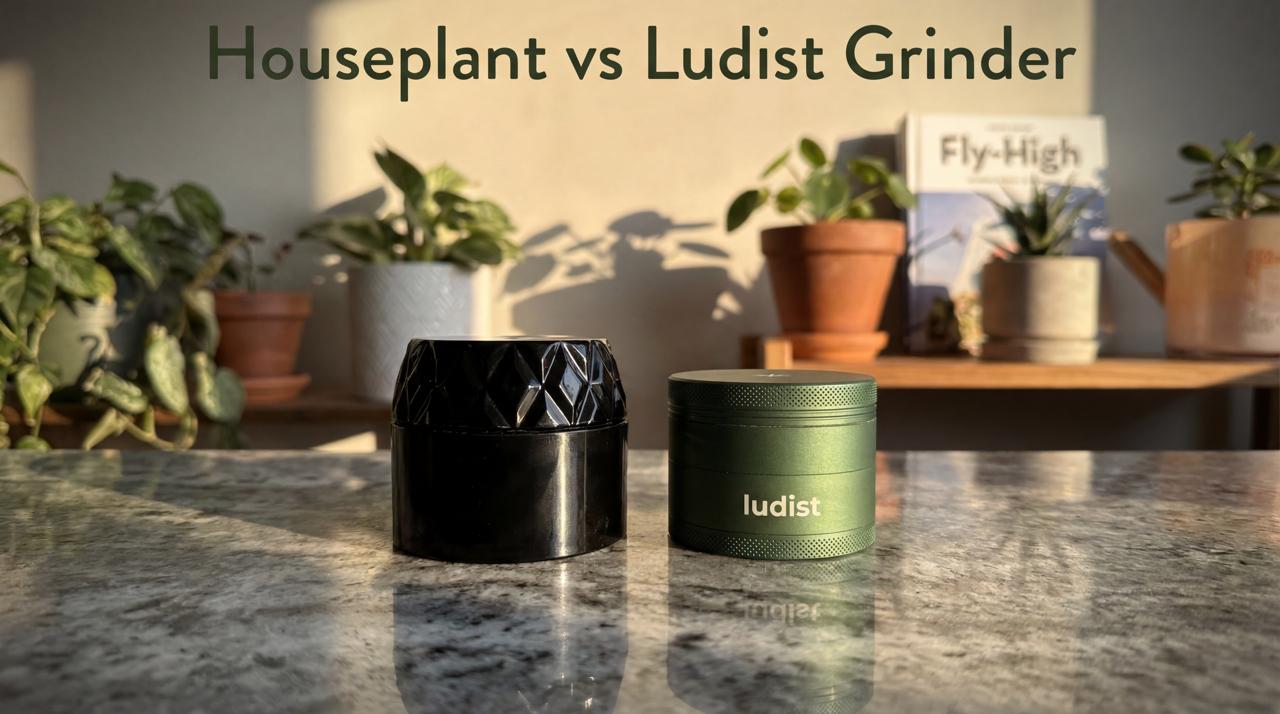
Houseplant vs Ludist Grinder: Which Premium Grinder Actually Delivers?
I spent ~$135 on this Houseplant vs Ludist Grinder comparison. $95 for Seth Rogen's glass grinder and $39 for the Ludist aluminum grinder. Three months of daily testing revealed which one actually earns its price tag. The performance gap surprised me more than the $60 price difference.
Seth Rogen's Houseplant grinder looks stunning on a shelf. The colorful borosilicate glass catches light beautifully, and guests always ask about it. Looking good and grinding well turned out to be very different things. The Ludist grinder doesn't demand attention the same way, yet it became the one I reached for every single day.
Most people want a grinder that feels good in the hand, works every time, and adds something extra to the experience. I tested both with everything from sticky 28% THC Gelato to bone-dry outdoor flower to find out which one delivers. When shopping for the best weed grinders, performance beats aesthetics every time.
Today, we'll cover:
-
How each grinder performs and feels in everyday use
-
What you're actually paying for at each price point
-
Which grinder enhances the ritual, versus just looking good doing it
Houseplant vs Ludist Grinder: Design Philosophy and First Impressions
The Houseplant vs Ludist Grinder debate starts the moment you unbox each one.
Houseplant arrives like a gallery piece. The glass grinder comes in vibrant colors (green, blue, black, amber) with decorative patterns that genuinely belong on a coffee table. It weighs about 12 ounces and feels substantial in your hands. The toothless glass surface uses raised divots instead of traditional teeth. At $95, you're paying for Seth Rogen's design vision and that nostalgic candy-dish aesthetic.
In contrast, the Ludist Weed Grinder takes a completely different approach. Available in colors like Jungle Green, Powder White, or Blackout., its matte finish and compact aluminum form feel clean, understated and deliberate. It weighs just 3.2 ounces but feels solid and purposeful. The 2.5-inch diameter fits perfectly in one hand. When I first held both grinders, the Houseplant felt like an heirloom, while the Ludist felt like a precision tool built for a specific job.

I kept the Houseplant on my rolling tray for the first week purely for aesthetics. By week two, I stopped bothering. The Ludist just worked better every single time.
The real design difference isn't about looks. It's about what happens when you actually use these grinders daily. The Houseplant demands careful handling. The Ludist invites heavy use without worrying about damage.
Material Construction: Glass vs Aluminum Durability Test
Three months of daily grinding revealed the brutal truth about material choices.
Borosilicate glass sounds premium and it is durable for drinkware, but I dropped the Houseplant from waist height onto a wooden floor during week five. The glass survived, but my anxiety didn't. Every subsequent use felt risky. Glass doesn't forgive concrete, tile or any hard surface. While it feels substantial and smooth, it's also heavy, breakable and not exactly travel-friendly. One accidental drop and you might be out ninety-five bucks.
The toothless glass surface also presents cleaning challenges. Resin builds up in those decorative divots faster than I expected. By day ten, I noticed dark residue collecting in the grooves. Getting it pristine again required isopropyl alcohol and patience.
On the flip side, the Ludist grinder is crafted from anodized aluminum with a soft matte finish. As a 4-piece aluminum grinder, it's lightweight but solid; I accidentally knocked the Ludist off my desk twice (onto tile), tossed it in my backpack without a case and even left it outside overnight once. Not a scratch on the matte finish. The metal herb grinder construction provides durability that glass alternatives can’t match.

|
Feature |
Houseplant Grinder |
Ludist Grinder |
|---|---|---|
|
Material |
Borosilicate Glass |
Anodized Aluminum |
|
Weight |
12 oz |
3.2 oz |
|
Drop Resistance |
Fragile, one drop could end it |
Highly durable, survives falls |
|
Resin Buildup |
Accumulates in glass divots |
Minimal due to anodized surface |
|
Travel-Friendly |
No, too fragile and heavy |
Yes, lightweight and durable |
|
Price |
$95 |
$39 |
The aluminum also stays cleaner between deep cleans. I tested this directly by grinding the same amount and strain in both grinders, then waiting three weeks. The Houseplant's glass divots looked noticeably grimier. The Ludist's teeth still had visible metal between the resin.
For anyone wondering about aluminum grinder safety, quality anodized aluminum won't flake or contaminate your flower. The anodization process creates a hard, stable surface layer that's actually safer than cheap uncoated aluminum. It's built for movement, made to last and won't shatter under pressure (literally).
Detailed Durability Test Data
Over three months, I subjected both grinders to conditions that mirror real-world use and abuse:
Drop Tests:
-
Houseplant: Dropped from 3 feet onto wood (survived but chipped edge), dropped from 2 feet onto tile (didn't risk it after wood incident)
-
Ludist: Dropped from 3 feet onto tile (no damage), 4 feet onto concrete (minor scuff on bottom), 5 feet into gravel driveway (purely cosmetic scratches)
Daily Wear Tracking:
-
Week 1-4: Both grinders performed identically with fresh flower

-
Week 5-8: Houseplant's glass divots showed visible resin darkening, required deep cleaning. Ludist showed minimal buildup

-
Week 9-12: Houseplant needed cleaning every 3-4 days to maintain performance. Ludist maintained smooth operation with weekly cleaning

Maintenance Requirements Comparison:
The Houseplant requires more frequent attention. The glass-on-glass contact means resin builds on both surfaces simultaneously. You need isopropyl alcohol, cotton swabs, and patience to clean those decorative divots properly. Each deep clean takes about 15 minutes.
The Ludist's maintenance routine takes 5 minutes with the included tools. The anodized surface naturally resists buildup, and when resin does accumulate, it comes off easily. Our comprehensive guide on [how to clean a weed grinder](https://meetludist.com/blogs/fly-high/how-to-clean-a-weed-grinder) walks through techniques for both material types, but aluminum consistently requires less effort.
Over three months, I spent approximately 90 minutes cleaning the Houseplant versus 30 minutes maintaining the Ludist. That's an hour saved every quarter, and the Ludist never lost performance between cleanings.
Grinding Performance: Teeth vs Divots in Real-World Testing
This is where the Ludist Grinder vs Houseplant Grinder comparison gets interesting.
The Houseplant uses a flat grinding surface with raised glass divots arranged in a decorative pattern. You place flower between the top and bottom sections, then twist. The divots compress and tear the flower rather than slicing through it. With dry, crumbly flower, it works adequately. With sticky strains, the experience becomes frustrating.

I tested both grinders with the same batch of fresh Gelato (testing at around 28% THC, extremely sticky). The Houseplant required significantly more pressure to break down the flower. My hand actually got tired after grinding enough for five joints. The divots mashed the sticky trichomes into the glass surface rather than creating a clean grind. Worse, about 20% of each grind remained in larger, uneven chunks that I had to pick out by hand.
The Ludist's diamond-cut metal teeth delivered completely different results with that same sticky Gelato. The razor-sharp teeth sliced through the flower with minimal resistance. Three gentle twists and I had perfectly fluffy, evenly ground flower. The consistency looked like what you'd get from a premium coffee grinder, just coarser for optimal airflow.
Grind consistency matters more than most people realize. Even grinding creates better airflow in joints, more efficient vaporizer sessions and slower, more controlled burns. Testing both grinders with the same strains made this obvious:
-
Houseplant grind: 60% medium chunks, 30% fine powder, 10% large pieces that needed reprocessing
-
Ludist grind: 85% consistent medium-coarse texture, 15% fine (fell through holes), perfect for rolling
The difference showed up immediately when rolling joints. The Houseplant's uneven grind created air pockets that caused runs and uneven burning.
The Ludist's consistent grind packed smoothly and burned evenly from tip to filter.
If you want to understand the mechanics behind this, our guide on how does a weed grinder work explains why tooth design impacts grinding quality.
Kief Collection: The Feature Houseplant Completely Skips
Here's something that genuinely shocked me about the Houseplant grinder: there's no kief catcher at all.

The glass design means all those valuable trichomes that shake loose during grinding either stick to the glass surface or get mixed back into your ground flower. Over three months of regular use, I watched premium trichomes just disappear into the glass divots. Try to scrape them out and you risk scratching the decorative surface.
The Ludist includes a precision-engineered 100-micron kief screen in its 4-piece design. For anyone searching for the best grinders for preserving trichomes on hemp buds, this precision screen makes all the difference. Here's what I collected over the three-month testing period:
-
Week 1-4: Approximately 0.3 grams of golden kief
-
Week 5-8: Another 0.4 grams (grinding more frequently)
-
Week 9-12: An additional 0.5 grams
-
Total collected: 1.2 grams of pure kief
That's basically a free bowl topper every week. The kief chamber is deep enough that you won't accidentally dump it when opening the grinder. The screen stays clean and functional without clogging, even with sticky strains.

For those curious about maximizing trichome preservation, I tested several strains to see which grinder performed better at preserving trichomes on hemp buds. The Ludist's gentle cutting action and immediate trichome separation with the 100-micron kief screen proved far superior to the Houseplant's compression method.
And because it comes with a cleaning kit, it stays that way longer. If you want a more detailed breakdown of performance and features, check out our full Ludist Grinder review.
Doing the math: if you grind even a quarter ounce per month, you'll collect enough kief with the Ludist to justify its $39 price within about four months. The Houseplant will never collect anything beyond what sticks to the glass.
Ease of Use: Smooth Operation vs Hand Fatigue
The daily usability gap between these grinders became obvious by week two, with it only getting worse as time goes on.
Houseplant operation requires more effort than expected. The glass-on-glass contact creates friction, especially as resin builds up. Grinding dense, sticky flower means gripping firmly and applying steady pressure while twisting. My girlfriend (who has smaller hands and less grip strength) found it genuinely difficult to use with fresh, moist flower. After grinding enough for a party (about 3.5 grams), my hand felt tired.
The toothless design also means you can't really feel when the flower is fully ground. You have to open it periodically to check progress. This interrupts the flow and exposes your flower to air unnecessarily.
Ludist operation feels effortless by comparison. The magnetic lid snaps satisfyingly into place. The knurled grip texture provides excellent finger traction. Most importantly, the razor-sharp teeth require almost no pressure. I can grind with just my fingertips if needed. The smooth turning action comes from precision threading and the quality of the diamond-cut teeth.
You also get tactile feedback. When the teeth stop catching flower and the grinder spins freely, you know it's ground completely. No need to open and check.
I timed both grinders processing the same 0.5-gram nug of dense Purple Punch:
-
Houseplant: 47 seconds of active grinding plus two checks = ~60 seconds total
-
Ludist: 23 seconds of active grinding, one check = ~30 seconds total
The Ludist ground the same flower in half the time with noticeably less effort.
This daily ease-of-use advantage compounds over time. If you grind once per day, that's saving roughly 40 seconds per session. Over a month, that's 20 minutes of your life back. Small conveniences matter when something becomes part of your daily ritual.
Knowing all of the “tips and tricks” on how to use a weed grinder with proper technique and utilise all of its potential is essential for that ritual.
Price and Value Analysis: $95 vs $39 Over Time
Let's address the elephant in the room: that $60 price gap.
At $95, the Houseplant grinder positions itself as a luxury purchase. You're paying for Seth Rogen's brand recognition, premium borosilicate glass and conversation-starter aesthetics. What you're NOT getting: a kief catcher, maintenance tools, travel-friendly durability or superior grinding performance.
At $39, our Ludist Grinder includes a 4-piece aluminum construction with a kief catcher, custom care kit (titanium toothpick, precision brush, scraper), lifetime functionality, 2.5× more kief collection than standard grinders and premium matte finish that resists fingerprints.
I calculated the actual value difference by factoring in kief collection. Conservative estimate: you'll collect about 4 grams of kief annually with the Ludist. Where I live, kief sells for about $15-20 per gram at dispensaries. That's $60-80 worth of kief you'd otherwise purchase or lose completely with the Houseplant.
For anyone asking how much a weed grinder is worth spending on, the answer isn't about the upfront cost. It's about daily performance and long-term value.
Maintenance and Cleaning: Practical Long-Term Ownership
Three months revealed dramatically different maintenance requirements.
Cleaning the Houseplant became a weekly chore by month two. The decorative glass divots trap sticky resin that's genuinely difficult to remove. The glass-on-glass contact means both surfaces accumulate buildup simultaneously. You can't really scrape the glass without potentially damaging it.
Cleaning the Ludist takes minutes with the included tools. The titanium toothpick dislodges compacted flower from between teeth. The precision brush clears the kief screen without damaging it. The scraper collects valuable kief from the chamber walls.
The anodized aluminum naturally resists buildup. Even when resin accumulated, it came off easily with alcohol and a brush. The threads never cross-threaded or became difficult to turn.
If you're dealing with a heavily used grinder that needs attention, our comprehensive guide on how to clean a weed grinder walks through cleaning techniques for any grinder type.
Storage and Portability: Desktop Display vs Daily Carry
The Houseplant grinder excels as a stationary display piece. At 12 ounces with fragile glass construction, this isn't traveling anywhere safely. The anxiety of potential breakage wasn't worth it. The size also makes pocket carry impossible.
The Ludist is genuinely travel-friendly. At 3.2 ounces, it disappears into a backpack or coat pocket. The magnetic lid creates an airtight seal that effectively contains odors. I've carried it camping, to friends' houses and in my daily bag without any concerns.
The Houseplant's 12-ounce weight and fragile glass construction mean it stays home. If you need to transport your setup safely, consider a protective storage solution. Our guide to the best stash box covers options from basic protection to premium smell-proof cases with custom foam inserts that can accommodate both your grinder and supplies.
For anyone building a complete setup, the Ludist Grinder pairs beautifully with our rolling tray, presenting a full, organized rolling experience.

Grinder Types and Materials: Understanding Your Options
The Houseplant vs Ludist Grinder comparison represents two different philosophies in dried herb grinder design.
Glass grinders like Houseplant appeal to collectors and design enthusiasts. They offer unique aesthetic appeal and non-reactive material. But glass sacrifices practicality through fragility, heavy weight, often toothless design and typically lacks kief catchers.
Metal herb grinders like the Ludist represent the functional choice. Quality aluminum grinders provide superior durability, razor-sharp teeth that maintain their edge, precise threading, natural resin resistance from anodization and travel-friendly weight.
The 4 piece aluminum grinder design that Ludist uses is considered the gold standard for a reason. The four-chamber setup separates grinding, storage, screening and kief collection into optimized compartments.
Many types of weed grinders have different functionalities, materials, shapes, sizes, etc. Picking the right one for you might just be the missing puzzle in your smoking ritual.

Choosing the Right Grinder for Herbal Blends and CBD Use
How do I choose the right grinder for herbal blends? Well, this depends heavily on what you're grinding and how often.
For CBD flower and hemp buds, grind consistency becomes even more critical. CBD flower often has a different trichome structure than high-THC cannabis, and you want to preserve those cannabinoid-rich trichomes, not destroy them.
I tested both grinders with several hemp and CBD strains.
The Houseplant's compression method mashed the delicate hemp trichomes into the glass surface. The lack of a kief catcher meant all those valuable CBD-rich trichomes stayed stuck to the glass or got lost entirely.
The Ludist's cutting action cleanly separated the flower from the stem without excessive trichome damage. The kief that fell through the screen represented concentrated CBD that I could save and use separately.
The question is, what's the most durable grinder for daily CBD use? Based on three months of testing, the answer is clear: quality anodized aluminum beats glass for daily functionality.
Also, it is important to mention that if you use CBD and THC strains, it is preferable not to mix them, but rather to use two different grinders for each use case. Understanding the types of weed strains helps enhance your cannabis experience to the fullest.
The Complete Setup: Grinders, Storage, and Accessories
A quality manual metal herb grinder is just one piece of a complete cannabis setup.
During my testing period, I realized the grinder you choose influences your entire workflow. The Ludist's clean, minimalist design fits naturally into a thoughtful setup. I paired it with:
-
A high quality stash jar for airtight flower storage with humidity control
-
A premium hardwood stash box for organized tool storage
-
A smooth ash wood rolling tray to keep everything contained during the process
This cohesive setup improved my entire ritual. The grinder's magnetic lid prevented spills. The stash jar kept flower at perfect humidity. The stash box organized papers, filters and tools.

The rolling surface matters more than most people realize. A quality tray contains mess, provides a smooth rolling surface and keeps tools organized. If you're investing in a premium grinder like the Ludist, pair it with proper accessories. Our comparison of the best rolling trays covers everything from basic aluminum surfaces to premium wood options with built-in storage.
Common Questions About Premium Grinders
Do you need a grinder for weed, or can you just use your hands?
Technically, you can break up flower by hand, but you're losing trichomes to your fingers, creating uneven chunks that burn poorly and missing out on kief collection entirely. There is a whole science behind why it’s much better to have a grinder rather than breaking by hand, so the question of “Do you need a grinder for weed?” is already an absurd one.
Can I leave weed in my grinder between sessions?
Short-term storage (24-48 hours) is usually fine in a quality grinder with a magnetic seal, but knowing all the details on whether you can leave weed in a grinder is useful for the long term.
Can you use a coffee grinder instead?
Please don't. Our article on whether you can use a coffee grinder for weed explains why this is always a bad idea.
Testing Methodology: How I Evaluated Both Grinders
Transparency matters in product comparisons. Here's exactly how I tested both grinders over three months:
-
Strains tested (all from licensed dispensaries with lab results): Gelato (28% THC), Purple Punch (24% THC), Sour Diesel (21% THC), Blue Dream (19% THC), Wedding Cake (26% THC), and various CBD/hemp strains (12-18% CBD).
-
Metrics measured: Grinding time, grind consistency, kief collection, ease of use, cleaning difficulty and durability.
-
Usage pattern: Ground approximately 0.5-1 gram per day, rotated between both grinders weekly, tested with both fresh and aged flower, and included feedback from girlfriend and friends.
Building Your Cannabis Ritual Around the Right Tools
Three months with both grinders taught me something important about ritual versus routine.
A routine is mechanical. You grind flower because you need to. The process is forgettable.
A ritual is intentional. You choose tools that enhance the experience. The process becomes meaningful.
The Houseplant grinder promises to elevate your ritual through design. In practice, its functional limitations turned grinding into a frustrating routine I wanted to rush through.
The Ludist grinder doesn't make bold aesthetic promises. It just works so smoothly and reliably that I found myself appreciating the grinding process itself. The satisfying magnetic click. The effortless twist. The fluffy, consistent result. That's the paradox: the grinder that doesn't try to be special ended up making grinding feel special.
Making the Right Choice for Your Cannabis Setup
After three months of daily testing, the verdict on Houseplant vs Ludist Grinder is clear.
The Houseplant grinder serves a specific purpose: aesthetic display. If you want a conversation piece that looks stunning on a shelf and you only grind occasionally, it delivers. But for anyone who actually grinds regularly, the functional compromises aren't worth the premium price. No kief collection. Fragile construction. Inconsistent grinding. Extra maintenance effort. Zero portability.
A quality grinder like the Ludist Grinder represents the opposite philosophy: substance over style, though the matte finish and clean design still look great. At $39 with included care tools, it delivers premium grinding performance without the premium price.
The razor-sharp teeth glide through any strain. The 100-micron screen collects 2.5× more kief than standard grinders. The anodized aluminum survives drops and daily use. The magnetic seal contains odors. The included care kit ensures easy maintenance. It's the grinder you'll actually use every single day without thinking about it.
I'm keeping the Houseplant grinder. It'll sit on a shelf as an interesting piece of cannabis culture. But I'm grinding with the Ludist every day, and I'm collecting valuable kief that the glass grinder would have wasted.

Your grinder should enhance your ritual, not complicate it. Choose accordingly.
Shop Ludist Grinder at MeetLudist – ⭐ 4.9 (600+ verified reviews)

Leave a comment
This site is protected by hCaptcha and the hCaptcha Privacy Policy and Terms of Service apply.